
Fireflies appear in the city from mid-May
Fireflies are loved as a symbol of early summer.
In 1954, from the practice of observing fireflies donated to the garden began Firefly Evenings. In order
to preserve the natural environment of Fireflies, Hotel Chinzaso Tokyo takes part in a variety of
initiatives. To enjoy the same beautiful spectacle in the future, we pledge to maintain this oasis
bringing relaxation to all our guests.
Regarding entry into the garden
Guests making use of the facilities at Hotel Chinzanso Tokyo including accommodations, restaurants,
events, and shops may enter the garden.
For guests not making use of the hotel, we sell a limited
number
of garden entry tickets per day.
They will be made available on this page.
Sale date: From noon, April 30th (Thu.)
History and preservation activities for fireflies
-
1952
The ideal of cherishing nature was carried down in the garden from Duke Yamagata Aritomo. Eiichi Ogawa, first president of Fujita Kanko, restored the garden after the war with the ideal of creating an oasis among the heavily damaged Tokyo, and founded the Garden Restaurant Chinzanso, which would become the core of the hotel.
-
1954
Two years after the restaurant’s opening, the Firefly Evenings event was commenced in order to allow guests to view the 10,500 fireflies donated to the hotel within the expansive garden. The event carried on the founder’s wishes to allow children in Tokyo to experience fireflies, and create an environment with fireflies for young people who visit Tokyo and might be reminded of their hometowns.
-
1969
To maintain the firefly viewing, a laboratory for their breeding was founded. Although it no longer remains today, its purpose has been carried on through firefly breeding efforts.
-
2000
Based on the advice of a firefly specialist, the positioning of firefly breeding areas within the garden and adjustment of the stream’s water speed to promote breeding were improved. Efforts continue based on expert advice to improve the garden for the good of the fireflies.
-
Present
Constant maintenance and improvements are underway to preserve a natural habitat for fireflies, and a location where people can view their beautifully dancing forms.
Environmental study with local elementary school students
Beginning in 2003, Hotel Chinzanso Tokyo has invited local elementary school students to take part in the release of firefly larvae each year. (2021 was held with staff only due to circumstances in Japan at the time.) By allowing children to learn more about the lifecycle of fireflies and observe their larvae being released, the event has educated about nature and the importance of life.
Efforts by the staff
-
Maintaining clean soil for the fireflies
In order to protect the area for fireflies, capsules containing solutions to protect them from pests are inserted directly into the trunks of cherry blossom trees, and sprayed in the area of the stream from March through July to keep the soil pure.
-
Consideration toward the fireflies while pruning
Consideration is given to the breeding season and firefly viewing when pruning trees, concluding the process by the end of March when they emerge. Most pruning occurs during summer, when they are not affected.
-
Tokyo Sea of Clouds adjusted during viewing season
Considering the possibility of mist from the Tokyo Sea of Clouds affecting the flight of fireflies, during the viewing season, mist is not emitted in the area in which they are viewed.
The ecology of fireflies
-
All about fireflies
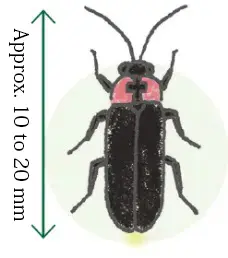
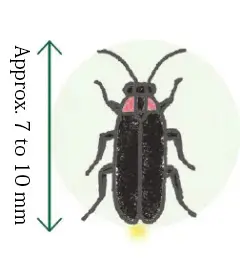
Like rhinoceros beetles, fireflies are a kind of beetle. Among around 50 species found in Japan, the Genji firefly and Heike firefly are especially well known, but the fireflies raised at Hotel Chinzanzo are Genji fireflies.

Genji fireflies
The largest found in Japan
Glow slowly
Flutter as they fly
Have a black crossed line on a red body
Heike fireflies
Smaller than the Genji firefly
Flash quickly
Fly in straight lines
Have a thick black mark on a red body
-
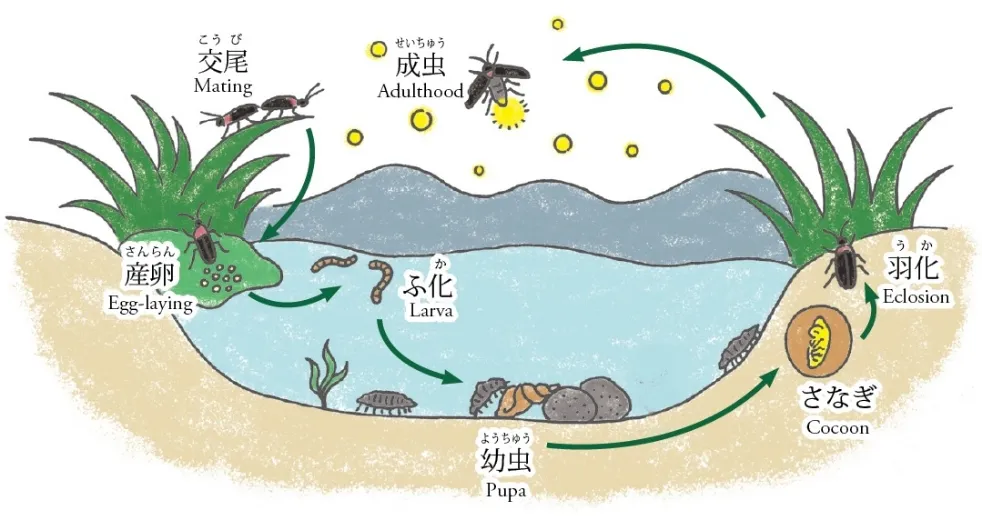
The life cycle of fireflies
Eggs laid from May to July hatch after around a month, and the firefly larvae live in the water for around 10 months. The next spring they spend around 3 weeks in a cocoon in the soil, and mature to adulthood in around 10 days. It’s said that as an adult, a firefly can fly for just 1 to 2 weeks.
-
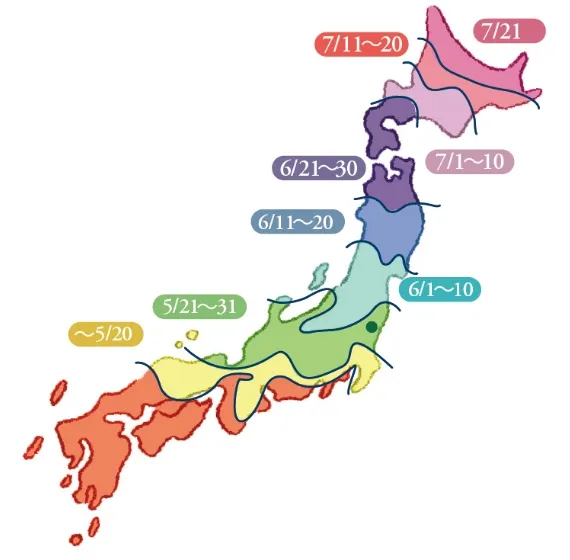
Firefly viewing seasons
The time fireflies take flight differs with location and weather conditions. Fireflies in warmer southern regions are the earliest to take flight.
*Regional seasons are estimations.
The fireflies at Hotel Chinzanso Tokyo can be enjoyed every year from mid-May!
-
Why do fireflies glow?
Fireflies have luminescent cells in their body used for males to appeal to females, to warn other fireflies of predators, and other such communication.
What do fireflies eat?
As larvae, Genji fireflies mainly consume freshwater snails, which are found in rivers and ponds with pure waters. When fireflies become adults, they no longer feed, and only drink water.
The nature-rich garden of Hotel Chinzanso Tokyo has stream water that flows in from the Chichibu Mountains. This pure water is ideal for nurturing the snails on which fireflies feed, allowing viewing of fireflies even within the city.

Reference:
Mikami Town firefly information
https://www.town.minakami.gunma.jp/life/09sumai/kankyou/files/hotaruttedonnamushi_R1.pdf
Kajima Kids’ Academy
https://www.kajima.co.jp/enjoy/kids_env/try/look_for_firefly/know/index.html
Fireflies are visible from mid-May
Firefly viewing spots in the
garden
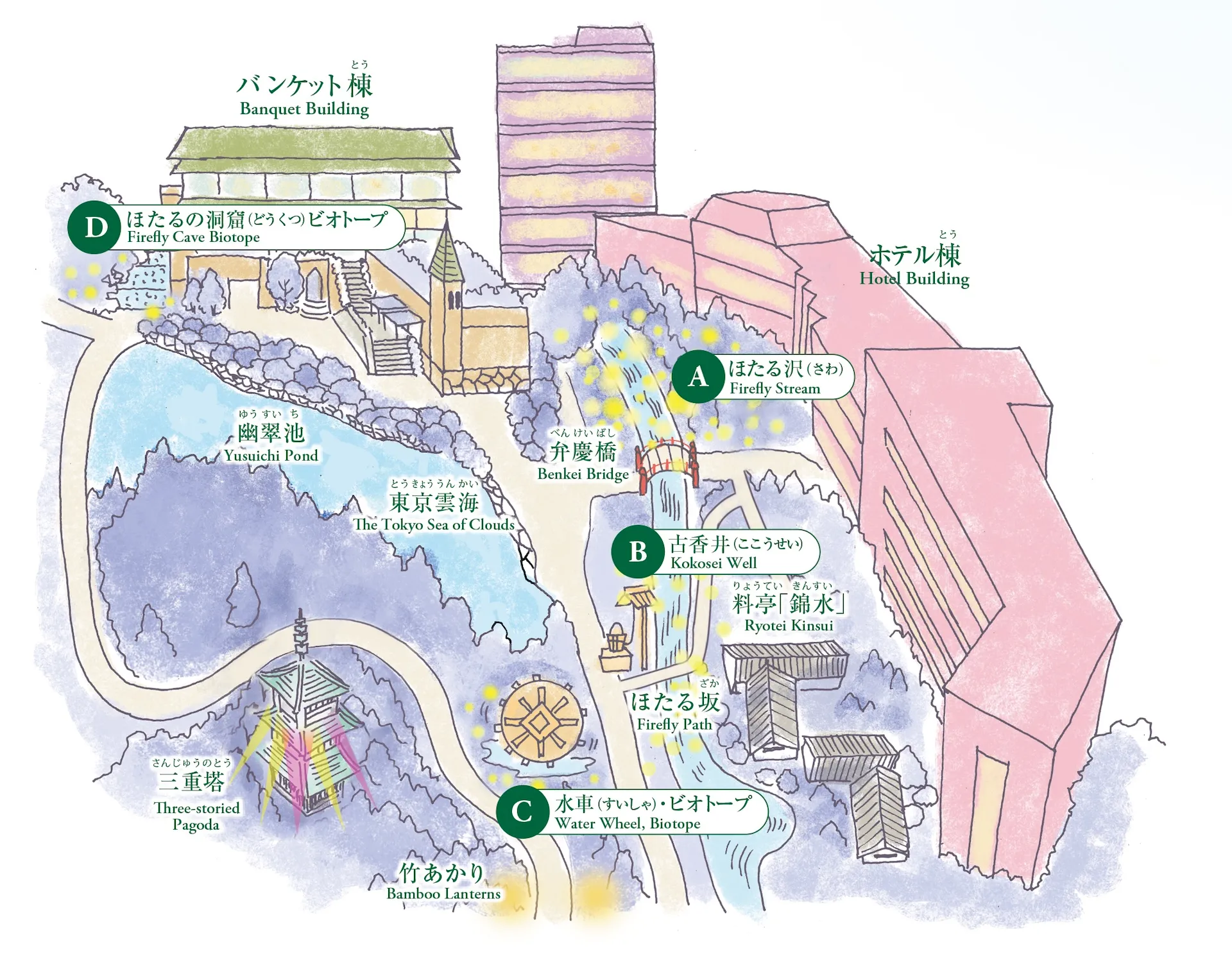
During the firefly viewing period, the area beside Firefly Stream is a one-way path.
-
Firefly Stream
Running under the red Benkei Bridge, this stream provides an environment for the freshwater snails on which firefly larvae feed. The light of the fireflies seen from the bridge is a magical sight.
-
Kokosei Well
This well is the site where pure spring water from the Chichibu Mountains emerges from the ground. Around this water well known in Tokyo for its purity, many fireflies can be seen in flight.
-
Waterwheel, Biotope
The fireflies also show their beautiful light in the area of the water wheel. It’s a sight that recreated a tradition view of the Japanese countryside. A biotope is also located here.
-
Firefly Cave Biotope
This biotope was installed nearby the water area fireflies call their home. Since it’s located indoors, guests can take their time enjoying firefly viewing even in rainy weather.
Recommended viewing time:
As the fireflies glow faintly, they are best viewed when the area is
dark.
(Around 7:30 p.m. or later)
Firefly viewing etiquette
The hotel is visited by guests of all nationalities and ages.
In order for the experience to be enjoyed by everyone, we request the following etiquette.

No flash photography
Since it disturbs the fireflies, we ask that guests retain from flash photography. Please confirm your camera settings in advance.

No tripod use
Use of camera tripods is not permitted in the hotel or garden.

Please view quietly
Fireflies are easily disturbed by loud noises, so we ask that guests refrain from speaking loudly. Conversations should be had quietly if possible.

Walk slowly
In order to view the fireflies, the garden is being lit dimly, including the walkway, which may be difficult to see in the dark. We ask that guests walk slowly.

Watch your step
The garden contains steps and hills. If you require light in order to walk in the garden, we request that you illuminate the area around your feet only to the extent necessary.

Take care not to drop belongings
Please take care not to drop belongings, as objects like smartphones dropped in the pond or stream may be difficult to retrieve quickly.

Make space for other guests
In order to allow all guests to enjoy the fireflies, please be aware of other guests and make space for them.

Be kind to the fireflies
We ask that guests only view the fireflies, and do not attempt to catch or otherwise touch them. The fireflies are very delicate, and if one happens to land on your hand, please gently return it to a leaf or elsewhere.
・The garden is only available to guests making use of the hotel, but guests with firefly-viewing tickets may also enter during this season.
・Fireflies may sometimes not be visible outdoors due to weather or breeding conditions. On rainy days or from mid-June on, we encourage guests to view the fireflies indoors or at the cave biotope.
・From mid-June on, guests can view the fireflies indoors or at the cave biotope.
Regarding entry into the garden
Guests making use of the facilities at Hotel Chinzanso Tokyo including accommodations, restaurants, events, and shops may enter the garden.
For guests not making use of the hotel, we sell a limited
number of garden entry tickets per day.
They will be made available on this page.
Sale date: From noon, April 30th (Thu.)